
Selected work · James Burden, M.Sc., RSLP

Clinical expertise.
Applied AI.
Useful systems.

I evaluate AI outputs, develop research and learning resources, and design practical workflows—drawing on approximately 17 years as a Registered Speech-Language Pathologist and clinical educator.

James Burden, Registered Speech-Language Pathologist

A consistent thread

Understand the need. Build something usable. Check what happens. Improve from evidence.

Clinical & educational experience
17 years
School caseload within 20 school hours per week
Up to 80 students
Clinical education and mentorship
9 student SLPs

Clinical practice meets applied AI

Selected projects.
Work you can inspect.

Start with four featured projects, then explore related work. Each case shows what I contributed and includes the relevant tools, excerpts or results.

8 projects shown

Featured projects

4 projects

Clinical systems

Clinical service systems — Kenneth Gordon

Assessment, staff coaching and coordinated support for a school caseload of up to 80 students.

Work sample · assessment framework

Area assessedObservable evidence
Narrative & perspectiveStory elements, plans versus actions, another character's viewpoint
Emotion interpretationLabels, visual expressions, intensity and situational cues
Social cause & effectHow impressions change across interactions
ConversationUsing another person's interests to initiate an exchange

Portfolio reconstruction of categories in an archived clinical report. Tasks distinguished independent understanding from performance requiring visual or verbal prompts; individual records are omitted.

My contribution & approach
The problem

An intensive school caseload needed support beyond the therapy room. Students' communication and learning needs had to be understood and addressed consistently by the adults working with them.

My work

Over my 2012–2023 school tenure, the caseload grew from approximately 30 to 80 students within 20 school hours per week. I assessed individual needs and coordinated evidence-based intervention across individual sessions, tutoring, small groups and classrooms. I trained staff, modelled strategies, maintained shared documentation and wrote final SLP reports.

I also supervised nine student SLPs—eight from UBC and one from the University of Alberta—teaching assessment judgment, measurable goals, reporting and effective collaboration.

How decisions were made

Observation and clinical interviews tracked the number and types of prompts needed to demonstrate understanding. Greater independence informed a move to less intensive support. The assessment framework below shows the categories and kinds of evidence I used, without exposing individual student records.

Capabilities: Clinical assessment, service design, staff development and progress-informed decisions.

AI evaluation

Testing whether AI workflows actually work

A sustained practice of comparing behaviour, detecting regressions and improving workflows—then turning the lessons into a reusable testing skill.

Selected evidence · three kinds of evaluation

WorkflowWhat the testing revealed
Conversational behaviourReflective-listening instructions needed revision when the AI moved into drafting too soon. Immediate improvement still needed to be distinguished from persistence.
Multi-stage researchA newer prompt improved several outputs but lost a useful feedback function and produced a longer companion. The review identified what to retain, restore and shorten.
Semantic extractionA revised Synchronicity Machine prompt handled missing information more consistently and reduced duplicates and unsupported additions while preserving supported content.

Drawn from retained testing records. I led the questions and review, with AI-assisted execution and analysis. Expand below for methods, results and the reusable Behaviour Testing skill.

My contribution & approach
My work

I developed and refined AI workflows through structured comparisons, examination of failures and repeated testing—from conversational behaviour to multi-stage research and semantic extraction. I defined the questions, challenged interpretations and reviewed whether outputs served their intended purpose. AI assisted with implementation, execution and analysis.

Conversational behaviour: make the preference observable

I investigated how to encourage useful curiosity, reflective listening and initiative without repetitive questioning or premature drafting. I required exact prompts and outputs to be retained, inspected settings and compared instructions in fresh chats. When reflective listening gave way to drafting too soon, the instructions were revised and later samples examined for that failure.

I also challenged a critical inference: an immediate change in behaviour does not establish that the change persists over time. Baseline comparisons that showed no demonstrated added benefit informed what we could claim.

Multi-stage research: check what an upgrade loses

I directed comparisons of research-prompt versions using matched inputs and separate executions. In one staged comparison, public research was frozen before the same private-context packet was supplied to each condition. The review examined both useful additions and material lost between versions.

The newer version improved several parts of the workflow but omitted a distinct confidential-feedback opportunity and produced a companion document approximately 32% longer. That finding supported retaining the stronger working version while restoring the missing function and shortening the companion. This was one matched comparison with AI-assisted, unblinded review; no recipient reading test was conducted.

Synchronicity Machine: repair a specific failure

A 48-response pilot compared original and revised extraction prompts across synthetic contexts. Correct handling of insufficient information improved from 0/6 to 6/6 test responses; redundant entries fell from 12 to zero, and replies with unsupported additions fell from seven to zero. Supported content and eligible output importability were preserved.

The repair separated clarification from list formatting and changed several instructions together. Execution and scoring were AI-assisted; these results support the bounded repair rather than a general reliability claim. The repaired wording was subsequently adopted.

Make the testing reusable

I distilled the experience into Design and Run AI Behavioural Experiments, a custom skill covering the question, comparison conditions, observable criteria, retained outputs and interpretation. It distinguishes development cases from fresh confirmation cases, and immediate behaviour from persistence. The result is a repeatable way to investigate the next workflow rather than starting from scratch.

Capabilities: Evaluation design, prompt comparison, regression analysis, human judgment and reusable testing procedures.

Knowledge systems

Living Library — source-linked knowledge retrieval

Recover prior decisions, inspect their original context and reuse the work without starting over.

Work sample · an evidence trail

How did the earlier AI-testing setup lead to the API experiments?

  1. 01
    Recover the original discussion

    The saved relay conversation records that browser-controlled testing became restricted.

    Source: Test ChatGPT Self Conversation · August–September 2026
  2. 02
    Distinguish a method from an executed test

    Later discussion recovers the API approach. That alone does not establish that trials ran.

    Source: Assess machine feasibility · September 2026
  3. 03
    Check the execution record

    Saved September 17 reports contain the actual prompts, responses and ratings from the completed comparisons.

    Source: Direct API comparison and iteration-test reports

A redacted walkthrough of a real recovery, assembled from its saved records. The useful answer preserved the difference between planning and completion.

My contribution & approach
The problem

Ideas, decisions and experiments were spread across conversations. Recovering a passage was not enough: I needed to distinguish a proposal from completed work and an older conclusion from its correction.

My work

I directed development of a personal retrieval system using Voyage-4 embeddings, local Qdrant search and an Obsidian review interface. Results link to original passages; reviewed notes preserve useful understanding. Search and update procedures retain source identity and reuse existing embeddings.

A concrete recovery

I remembered that we had solved an earlier AI-testing problem but could not remember how. Retrieval recovered the consumer-chat relay history and the later API approach. Reviewing the sources established the sequence: browser testing became restricted, an API method was proposed, and controlled API comparisons were later executed.

The evidence trail below shows the distinction the recovery preserved. It is a portfolio extract of that real history, rather than a new demonstration query.

Operational checks

Update records document preservation of existing material, opening original passages, retrieval of new material and a repeat update producing no new inputs. A six-run local comparison reduced median startup waiting from approximately 20 seconds to 1.4 seconds under the tested conditions.

Capabilities: Knowledge organization, retrieval workflows, provenance, process improvement and project continuity.

Product & UX

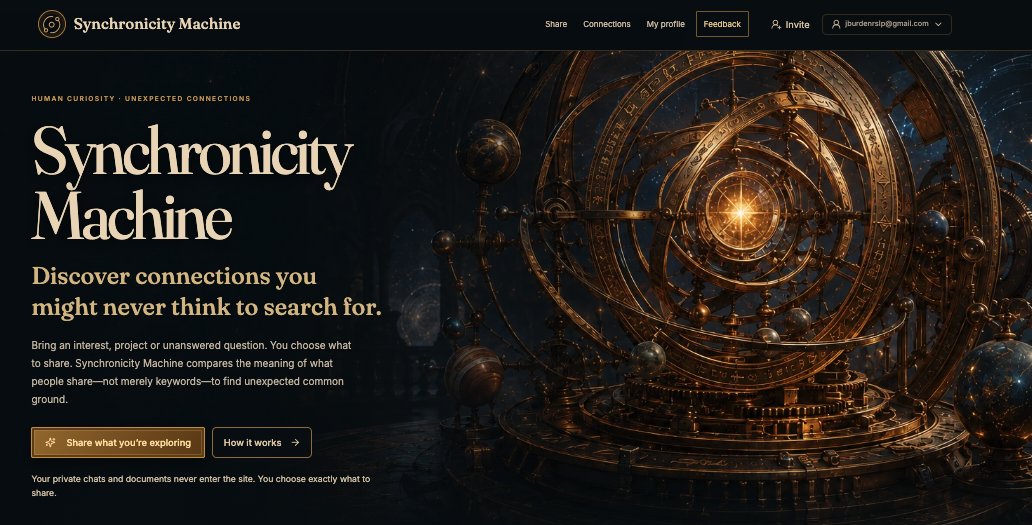
Synchronicity Machine — product & UX

A working app for finding meaningful connections between deliberately shared ideas.

Synchronicity Machine homepage: a dark gold visual identity, a clear introduction and an invitation to share an interest, project or question
Synchronicity Machine · product introduction and entry into the sharing workflow.
My contribution & approach
The problem

People can have a useful reason to connect even when their ideas are not simply similar. I wanted to make complementary perspectives and unexpected contributions easier to discover.

My work

I conceived and directed a Base44 app combining Voyage-4 semantic matching with a deeper process for exploring why a connection matters. People choose what to share; their own AI performs the richer reasoning through prompts and a two-transfer workflow. The app does not need an embedded generative-AI service for that reasoning.

I designed the journey from sharing an idea to understanding a connection and choosing whether to take contact further, and directed interface revisions and verification of saving, reopening and consent-related behaviour.

Evaluation in practice

I judged explanations as useful, qualified or unhelpful, rejecting ones that sounded clever but offered no worthwhile conversation opening. Controlled notification testing followed the interface action through to actual email delivery and exposed specific usability and inbox-placement issues for the improvement queue.

Visit Synchronicity Machine

Capabilities: Product definition, interaction design, semantic-matching workflows, implementation direction and acceptance review.

More selected work

4 projects

Clinical learning tools

Stuttering Blueprint — clinical practice tools

A client walkthrough and worksheet linking practice, self-assessment and the next decision.

Inspect the clinical tools

  1. Set a target
  2. Practise & record
  3. Self-assess
  4. Review & adjust
My contribution & approach
The need

Clients needed a repeatable way to practise between sessions, assess their speech and decide what to do next.

My work

As an RSLP, I developed and delivered online stuttering support using evidence-based tools and approaches, including Camperdown-based strategies, ACT principles and mindfulness. I created instructional videos and worksheets and used them with real clients.

The cycles sheet links a practice model, a trial target, self-assessment before recording review, a check against recorded performance and adjustment for the next trial. Intensity and naturalness are recorded separately, with client choice about speech goals.

Inspect the tools

Watch the cycles-sheet walkthrough

Open the portfolio worksheet sample

These are functional clinical resources designed for independent practice and self-monitoring. Demonstration entries illustrate the process, rather than representing client outcome data.

Capabilities: Evidence-based resource adaptation, clear instruction, client autonomy and practical feedback loops.

AI workflows

Skills Library — reusable AI procedures

Turn repeated work and hard-won lessons into instructions that can be used again.

Work sample · adopted custom skill, v0.4

Design and Run AI Behavioural Experiments

Before viewing new outputs, record the question, versions, cases, relevant outcome criteria, protected qualities, comparison, run/cost ceiling where applicable, and stopping rule. A brief record suffices for a small test. If outcomes were already seen, label criteria or analysis developed from them exploratory. Do not silently redefine success after results arrive.
Keep development cases separate from unseen confirmation cases when claiming transfer beyond tuning. Once a case or its outcome has guided revision, it is no longer untouched validation. Preserve it as regression evidence.

Selected text from the actual procedure. The skill also defines execution boundaries, record keeping, interpretation and completion.

My contribution & approach
The problem

Repeatedly explaining a task wastes effort. As instructions accumulate, they can overlap or lose the context needed to guide the next project.

My work

I developed custom skills for research, prompt development and improvement, retrieval and updates, project preservation, product improvement and behavioural experiments. Each procedure defines its trigger, sources, stages, handoffs and completion checks. I also worked on boundaries between skills so related methods serve distinct tasks.

Inspect an example

The excerpt below is from Design and Run AI Behavioural Experiments, an adopted skill developed from our testing history. It requires the question and success criteria to be recorded before new outputs are reviewed, and keeps development cases separate from fresh confirmation cases.

How I checked the procedures

Three isolated workflow cases tested one-item review boundaries, verification against the actual candidate revision and proportionate handling of a small repair. All met their recorded criteria in those cases. Versions and review records preserve what was adopted and what was tested.

Capabilities: Process design, operational writing, scope management, continuity and evidence-led maintenance.

Research & communication

Business exploration — research & decision support

A brief, a detailed evidence record and an AI companion designed for different uses.

Work sample · completed AI companion excerpt

Video-business opportunity exploration

For example, if someone asks for a customer's comment about installation disruption, an assistant might locate a promising moment in permitted footage and show the original context for an editor to check. That could help the team prepare a useful response. Whether it improves anything depends on how the work is handled today; your videographers or existing tools may already cover it well.
AI can suggest a match or label; it cannot establish consent or decide that a cut still represents the person fairly.

Extracted from a completed September 7 research deliverable; recipient and personal context omitted. The scenario is explicitly illustrative. It shows a possible use, the human decision and the existing-workflow check.

My contribution & approach
The need

A list of possible AI uses does little to help a business choose what is worth doing. Useful research must examine how the business creates value, what existing tools already provide and what remains unknown.

My work

Through self-directed explorations of video-production, beverage-promotion and other businesses, I developed a multi-stage workflow covering current capabilities, competing solutions, feasibility and economics. Its outputs serve three purposes: a short brief for orientation, a deeper research record for evidence and an AI companion for exploration with the recipient's own assistant.

A concrete editorial decision

An attempted companion read like a longer brief. I challenged it because its job was to equip the recipient's AI with context for a conversation—not make the person read another report. The result preserved uncertainty and invited the business owner to correct outside assumptions.

Inspect an excerpt

The extract below comes from a completed video-business exploration. It demonstrates a concrete scenario, an existing-workflow check and the decision that still belongs to the business. It describes an opportunity, rather than claiming an implemented commercial result.

Capabilities: Research synthesis, opportunity analysis, practical communication and AI-assisted knowledge transfer.

Learning & onboarding

Get-started.ai — AI onboarding

Collaborative development and testing of a beginner’s path to a useful AI conversation.

My contribution & approach
The need

For a beginner, a blank AI chat can be difficult to approach. Juno helps people explore what they want help with and prepare a personal introduction to use with an AI assistant.

My contribution

I worked with Matt through an emergent process of discussing ideas, trying approaches and testing the experience. The project grew from a practitioner-focused concept into broader professional support and then AI onboarding. Matt led most interface work; I contributed ideas, testing and evaluation.

What testing revealed

I helped examine a beginner's journey through Juno and into ChatGPT, combining the recorded journey with the first conversation turns. The review examined unclear next actions, reading and decision load, and difficulties transferring the introduction between devices.

A copied letter or opened chat window was not the meaningful endpoint. The person needed to get the introduction into the conversation and use it to begin.

Visit Get-started.ai

Capabilities: Learning-experience analysis, beginner onboarding and translating observed difficulties into development questions.

How I work

Expertise becomes valuable
when people can use it.

In schools, that meant assessing individual needs, teaching adults to use consistent strategies and checking progress across settings. In AI work, it means making the task explicit, preserving the evidence and inspecting whether the output serves its purpose.

I select and adapt evidence-based clinical tools, and bring the same care to emerging workflows: practical design, critical review and a willingness to revise the approach.

More about my clinical background

Work with me

Discuss a project.

Clinical domain review, AI evaluation, research and knowledge workflows, or practical learning resources.

Tell me what you need to produce, who it is for and what a useful outcome would look like.

base44
Edit with Base44